The story of the fighting knife in the American West begins with real men whose exploits forged an enduring icon. Jim Bowie (1796–1836)—duelist, land speculator, soldier—gained lasting fame not just at the Alamo but through the Sandbar Fight of 1827, where he wielded a large blade despite being shot and stabbed multiple times. Captain Jonathan R. Davis (1816–1887 or later), a U.S. Army veteran and Gold Rush prospector, etched his name in history on December 19, 1854, in Rocky Canyon, California, when he single-handedly killed 11 armed outlaws using two revolvers and a Bowie knife—one of the deadliest small-arms self-defense actions in frontier annals.
From these gritty origins, the Bowie knife transcended its practical roots to become a powerful American symbol, carried forward by myth, shaped by marketing, and elevated through art.
Myth and the Power of the Ideal
Myths arise from legend and truth, but they do far more than entertain: they capture the imagination and inspire growth. The Bowie knife, steeped in stories from books, television, and film, has proven nearly impossible to separate from its mythic aura. The 1952 film The Iron Mistress romanticized Bowie’s blade, much as tales of chivalrous knights like Percival or Galahad offered ideals for medieval warriors to pursue—not because perfection was attainable, but because striving for it forged better men.
The same principle holds in modern knife training. We sometimes reach the “bargaining position,” where an opponent faces a clear choice between life and death. Combat is never purely mechanical; it carries profound moral weight. Myths provide ideals worth chasing, quietly shaping the practitioner long after the blade is sheathed.
Marketing and the Dark Appeal
In a world saturated with marketing, the knife industry is no exception. Demand has driven evolution—from the heavy frontier Bowies to refined English Sheffield patterns, and modern icons like the Ka-Bar (adopted by the U.S. Marine Corps in WWII), the Crossada, or the Helles Belle. Yet a troubling trend persists: some marketing deliberately embraces the darkest elements of blade culture, selling paranoia, fear, and fantasies of criminal violence rather than defensive skill, historical respect, or honor.
Who truly benefits from this approach? It feeds mistrust and anxiety rather than building calm readiness and confidence. Those who teach combatives or sell knives bear responsibility—not only for what we impart but for the welfare and character of those we reach. We must hold ourselves—and our industry—to a higher standard.
The Art: Why We Train the “Pretty Stuff”
In a genuine self-defense encounter, most people revert to gross-motor, instinct-driven actions. So why devote time to fine-motor techniques, complex disarms, or elegant forms—the so-called “art”?
The reasons run deeper than combat efficacy alone:
Practicing refined skills strengthens gross-motor function and overall coordination.
We train not merely for the slim chance of a street fight, but for a fuller life—one that values life itself, even the lives of potential threats. Higher skill creates more options to preserve life rather than end it. To a hammer, everything is a nail.
The challenge is enjoyable, keeps the mind sharp, and fosters a superior learning environment.
Most importantly, diverse and complex training builds balance by elevating standards beyond raw aggression.
Martial arts have always served purposes beyond fighting. Disciplining the body disciplines the mind, strengthens character, reinforces ethics, and nurtures the spirit. Neglect any aspect—mind, body, or spirit—and the individual becomes unbalanced. A purely “practical” approach that dismisses beauty, morality, or growth risks producing lopsided, even dangerous people.
The Worthy Path: Life Savers or Life Takers
The ancient Greek poet Archilochus declared, “I have a high art: I hurt with cruelty those who harm me.” In contrast, Jesus taught, “Love your enemies,” and “Greater love has no one than this: to lay down one’s life for one’s friends.”
A disturbing modern trend promotes the base and criminal, glorifying violence for its own sake. Criminals may use weapons, but so do “good guys”. Yet those who teach and train others bear a duty to do so responsibly. One need not adopt a criminal mindset to defend against criminals. As Scripture observes, “As a man thinks in his heart, so is he.” Training that celebrates unchecked violence darkens the practitioner from within, training to value and preserve life elevates and enlightens the practitioner.
The wiser path returns to older virtues: honor, respect for life, by drawing inspiration from myth and legend. Even the legendary Bowie knife emerged from an honor culture, not a criminal one. We must challenge manipulative marketing and embrace the full art of the blade—technique, ethics, morality, honor, and respect—balancing mind, body, and spirit in a healthy, integrated way. Learning the way of the blade uniquely teaches reverence for life.
Western blade craft, at its best, remains a worthy pursuit—not merely a tool for survival, but a path toward becoming a fuller, more principled and balanced human being.
Steve Ledwith
Red Clay Combatives
February 26, 2026
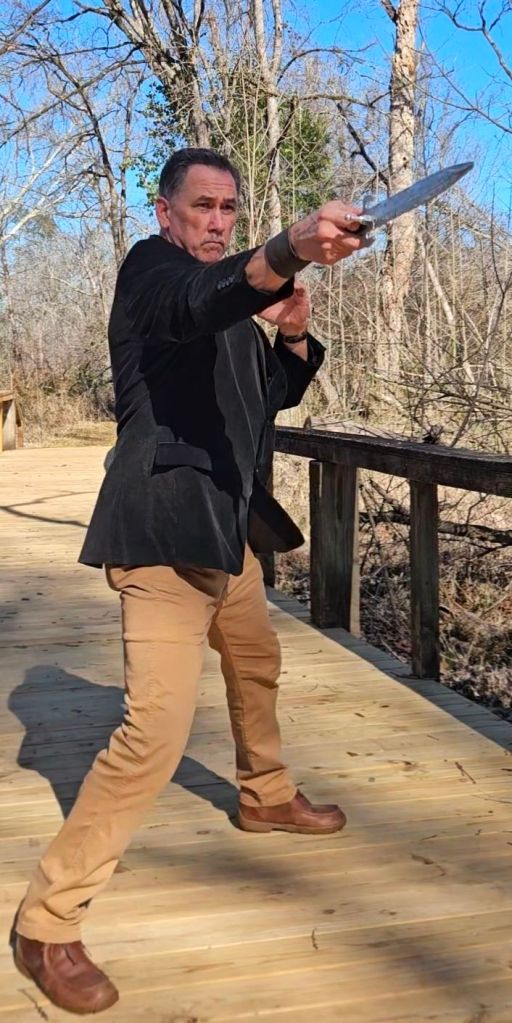
 Steve Ledwith’s Red Clay Combatives
Leave a comment